PPM Tool: How to Choose a Solution for Managing Your Projects and Project Portfolios?
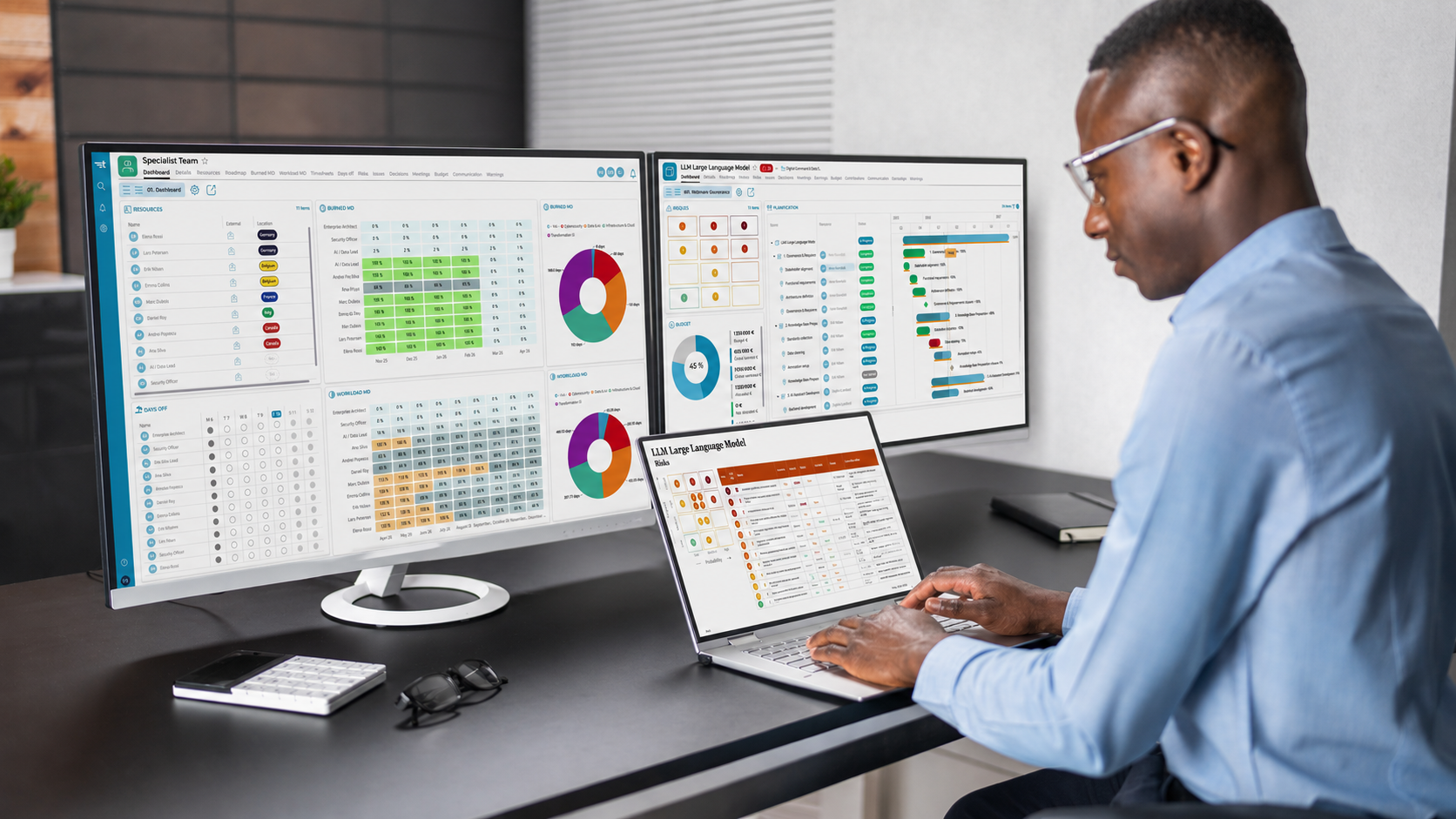
In many organizations, project management still relies on a combination of Excel spreadsheets, PowerPoint presentations, manual dashboards, and tracking systems scattered across teams. This approach may work on a small scale, but it quickly reaches its limits as the number of projects increases, stakeholders become more diverse, and governance bodies expect a reliable, consolidated, and up-to-date overview.
It is precisely in this context that a PPM tool comes into play. PPM, which stands for Project & Portfolio Management, refers to the management of projects and project portfolios. It enables an organization to centralize, structure, and manage all of its projects, programs, and portfolios by linking the operational monitoring of projects to a consolidated view of the portfolio.
This integration is essential: the quality of portfolio management depends directly on the quality of the data coming from the field. Progress, schedules, budgets, costs, risks, decisions, actions, or roadblocks: when this information is updated at the project level, it feeds into the portfolio view in real time, ensuring the reliability of consolidation and supporting decision-making.
Choosing a PPM solution, therefore, is not just about selecting a project tracking tool. It involves establishing a robust management foundation capable of helping project teams, PMOs, transformation departments, program management teams, and IT departments to better execute, consolidate, prioritize, make trade-offs, and report.
But how do you choose the right PPM tool? What criteria should you consider? And how can you ensure that the solution you choose will actually be adopted by your teams?
What is a PPM tool?
A PPM tool is a solution designed for project management and project portfolios. It brings together, within a single environment, all the information needed for operational monitoring, consolidation, governance, and decision-making.
Unlike a simple task management tool, a PPM solution does more than just organize work within a single project. It creates a direct link between project execution on the ground and the consolidated view needed to manage portfolios.
Its role is therefore twofold: to support teams in the operational management of their projects, while providing PMOs, program management teams, and decision-makers with up-to-date, reliable, and actionable data to guide decision-making at a broader level.
A PPM solution thus provides a multi-level view:
- operational monitoring of projects;
- program structure;
- the consolidation of project portfolios;
- budget monitoring;
- resource and expense management;
- risk management, actions, decisions, and dependencies;
- the preparation of reports;
- facilitating governance bodies.
The goal is to provide organizations with a clear overview of what has been launched, prioritized, is in progress, behind schedule, at risk, or awaiting a decision. The information entered and updated at the project level feeds directly into the portfolio view, which reduces the need for re-entry, improves the reliability of reports, and enables decision-making based on up-to-date data.
A PPM tool thus serves as a common point of reference for operational teams, project managers, program managers, PMOs, and decision-makers.
Why Organizations Need a PPM Solution
As the number of projects increases, manual management methods quickly become difficult to maintain. Files pile up, data is re-entered multiple times, reports are generated manually, and key information often circulates too slowly.
This dispersion creates several challenges:
- an incomplete picture of the actual progress of the projects;
- data that varies by team or department;
- reports that take a long time to produce and are sometimes already outdated by the time they are released;
- difficulty comparing projects with one another;
- a lack of visibility into risks, costs, and dependencies;
- more complex trade-offs at the portfolio level.
In a rapidly changing environment, these limitations can have a direct impact on the quality of management. Organizations need reliable data to make quick decisions, prioritize the right issues, ensure projects stay on track, and allocate resources where they’re needed most. A PPM solution addresses these challenges by organizing information and making project data actionable at various levels of analysis.
Key Criteria for Choosing a PPM Tool
The selection of a PPM tool must be based on the organization’s actual needs. It is not just a matter of comparing features, but of determining whether the solution is capable of supporting management practices, governance levels, and the teams’ day-to-day workflows.
1. A consolidated view of projects, programs, and portfolios
A good PPM tool should allow users to easily switch between a detailed view and a consolidated view.
Project teams need to track tasks, milestones, risks, actions, decisions, and workloads. PMOs and program management teams must be able to consolidate this information at the program or portfolio level. Decision-makers, for their part, need comprehensive, reliable, and immediately actionable metrics.
The solution must therefore offer multiple levels of interpretation:
- an operational perspective for project managers;
- a programmatic vision for program directors;
- a portfolio view for PMOs and management;
- a strategic overview for committees and sponsors.
This consolidation capability is central to project portfolio management. It provides a better understanding of overall progress, helps identify variances, and enables the prioritization of necessary actions.
2. Dashboards tailored to different user profiles
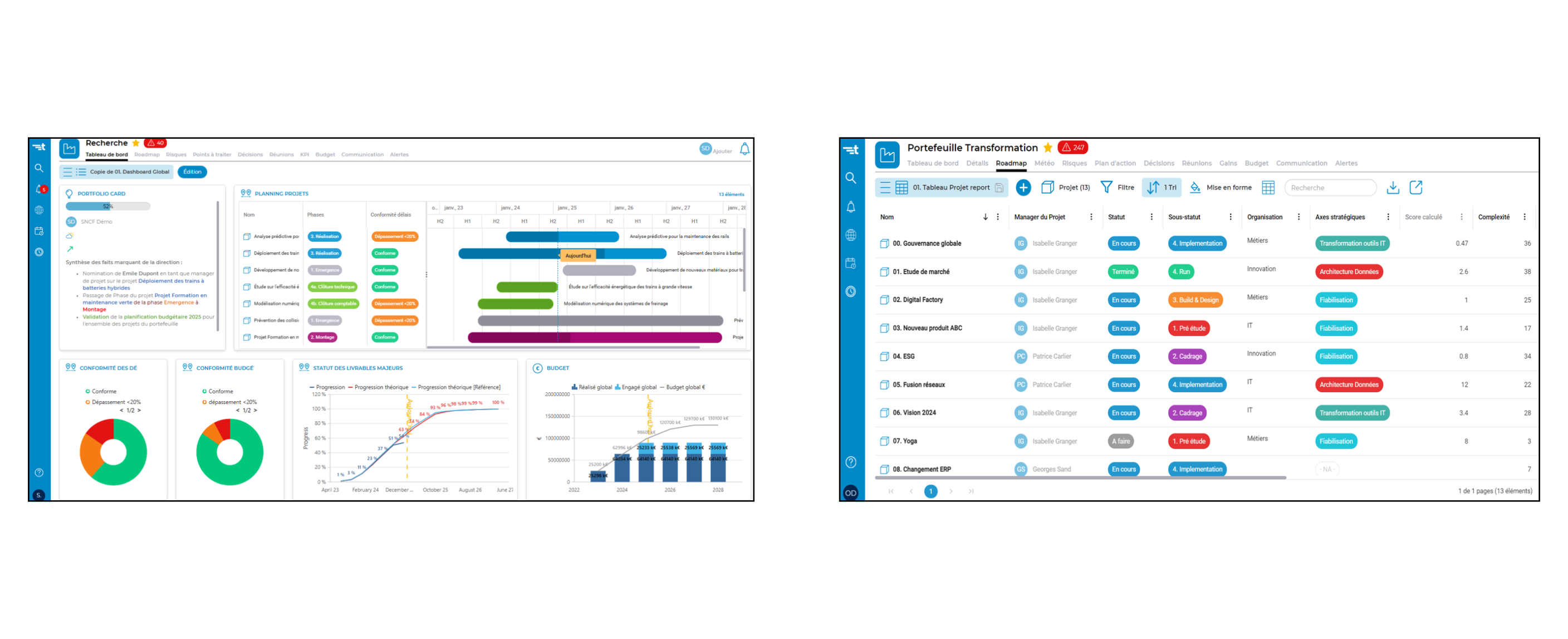
The project dashboard is one of the key components of a PPM tool. It provides a quick overview of the status of a project, program, or portfolio through shared metrics.
However, not all users need the same information. A project manager does not expect the same view as a PMO, a sponsor, a transformation director, or a member of the executive committee.
An effective PPM solution must therefore allow users to create dashboards tailored to different profiles: project progress, milestone achievement, budget tracking, cost consumption, resource availability, risk level, pending decisions, alerts and bottlenecks, and performance trends.
The challenge is to provide the right information to the right person, at the right level of detail.
3. More Structured Project Governance
Governance is another key factor in choosing a PPM tool. The more projects there are, the more important it becomes to structure the processes for monitoring, approval, and dispute resolution.
A PPM tool should help prepare for and facilitate governance meetings, such as project committees, program committees, portfolio committees, transformation committees, or executive committees. It should enable the tracking of decisions, actions, risks, trade-offs, and points of attention within a common framework. This structured approach prevents the loss of information between committee meetings and facilitates continuity in management.
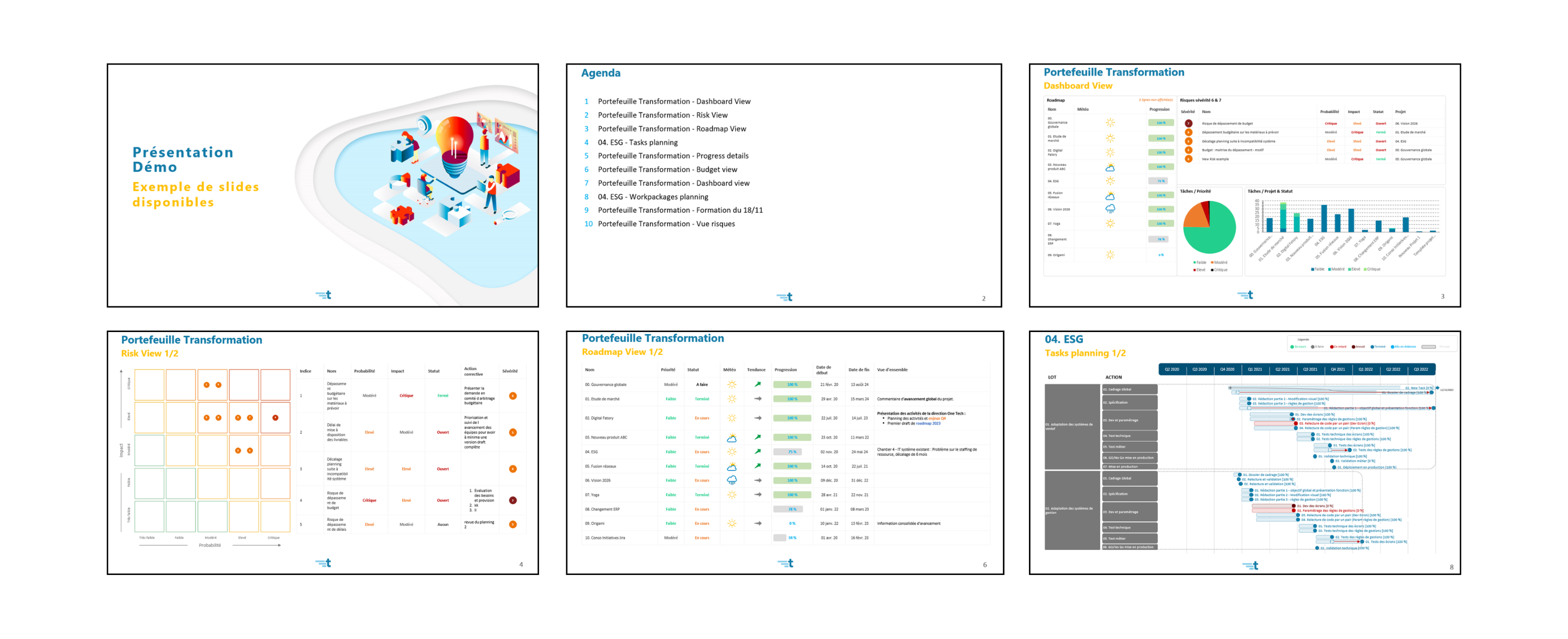
A good PPM solution should also facilitate the creation of governance materials, particularly the reports and presentations required by governing bodies. Automating these materials reduces the time spent creating slides and allows teams to refocus on analysis and decision-making.
4. Better management of resources and expenses
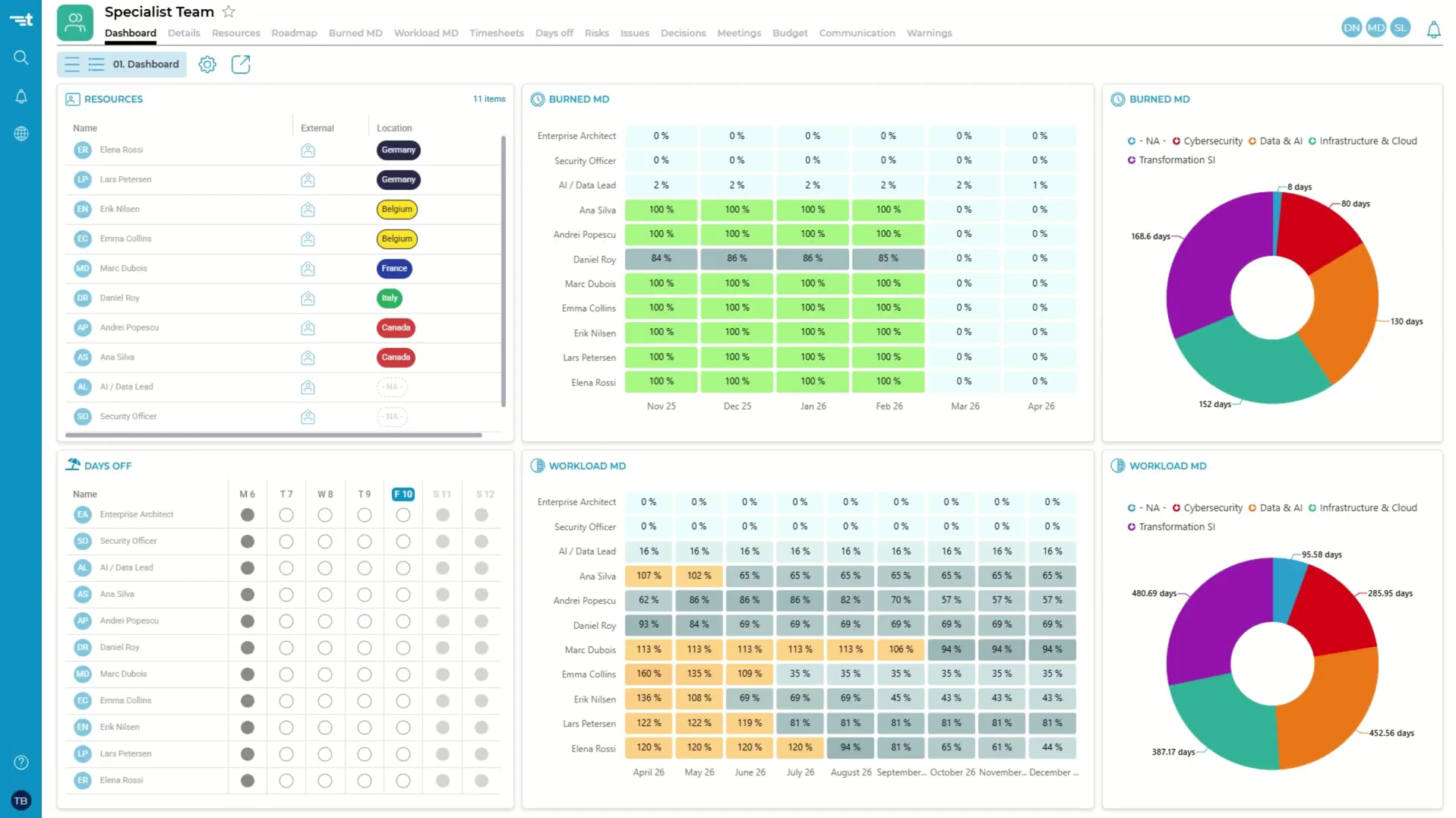
Project resource management is a critical aspect of portfolio management. Organizations need to be able to understand where their teams are assigned, what workloads are planned, what capacity is available, and which projects may compete for resources.
A PPM tool should therefore allow you to track:
- expected expenses;
- power consumption;
- availability;
- assignments;
- future needs;
- discrepancies between capacity and demand;
- what's left to do.
This perspective is essential for better balancing priorities, preventing teams from becoming overburdened, and ensuring projects stay on track.
In a multi-project environment, resource management cannot be separated from portfolio management. It must be linked to schedules, budgets, risks, and strategic objectives.
5. Clear tracking of budgets and performance
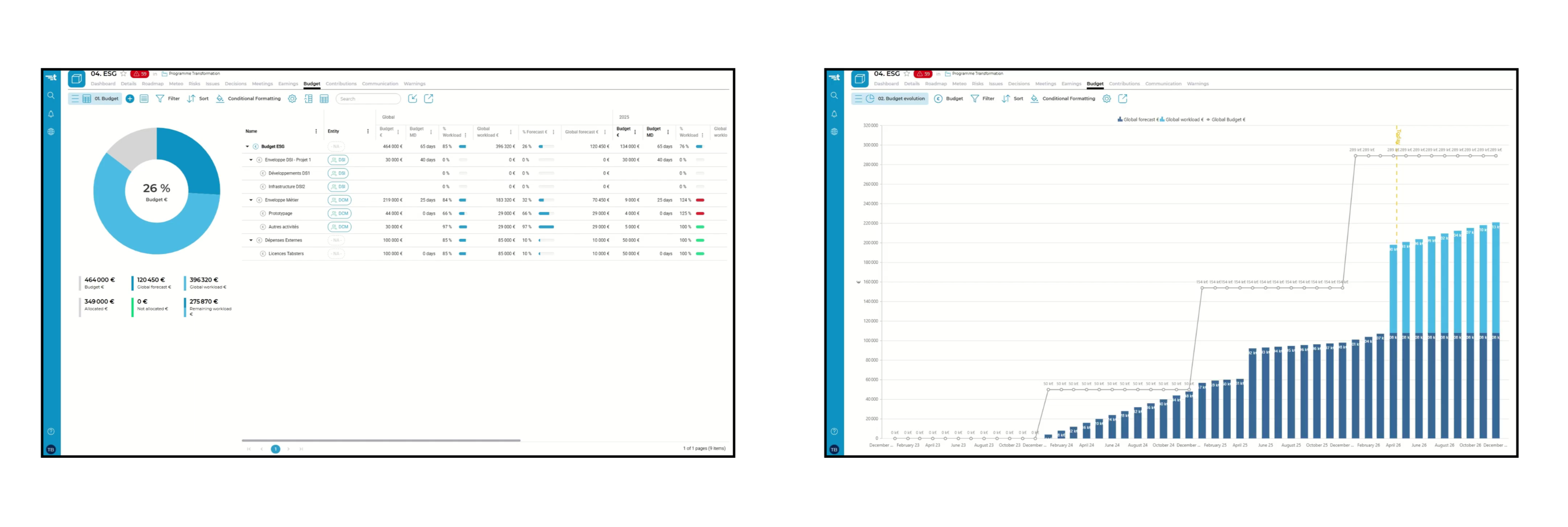
Budget tracking is another key factor in choosing a PPM solution. Departments must be able to track projected budgets, actual expenditures, variances, trends, and financial trade-offs at various levels.
A PPM tool should help answer several questions: Which projects are consuming the most budget? Which projects are over budget? What budgets are still available? Which investments are aligned with strategic priorities? How are costs changing over time? Which trade-offs need to be escalated to governance?
Budget management becomes particularly important when portfolios include transformation projects, IT projects, business initiatives, or multi-year programs. A PPM solution must therefore enable users to link budget, progress, risks, resources, and expected value.
6. A clear roadmap and schedule
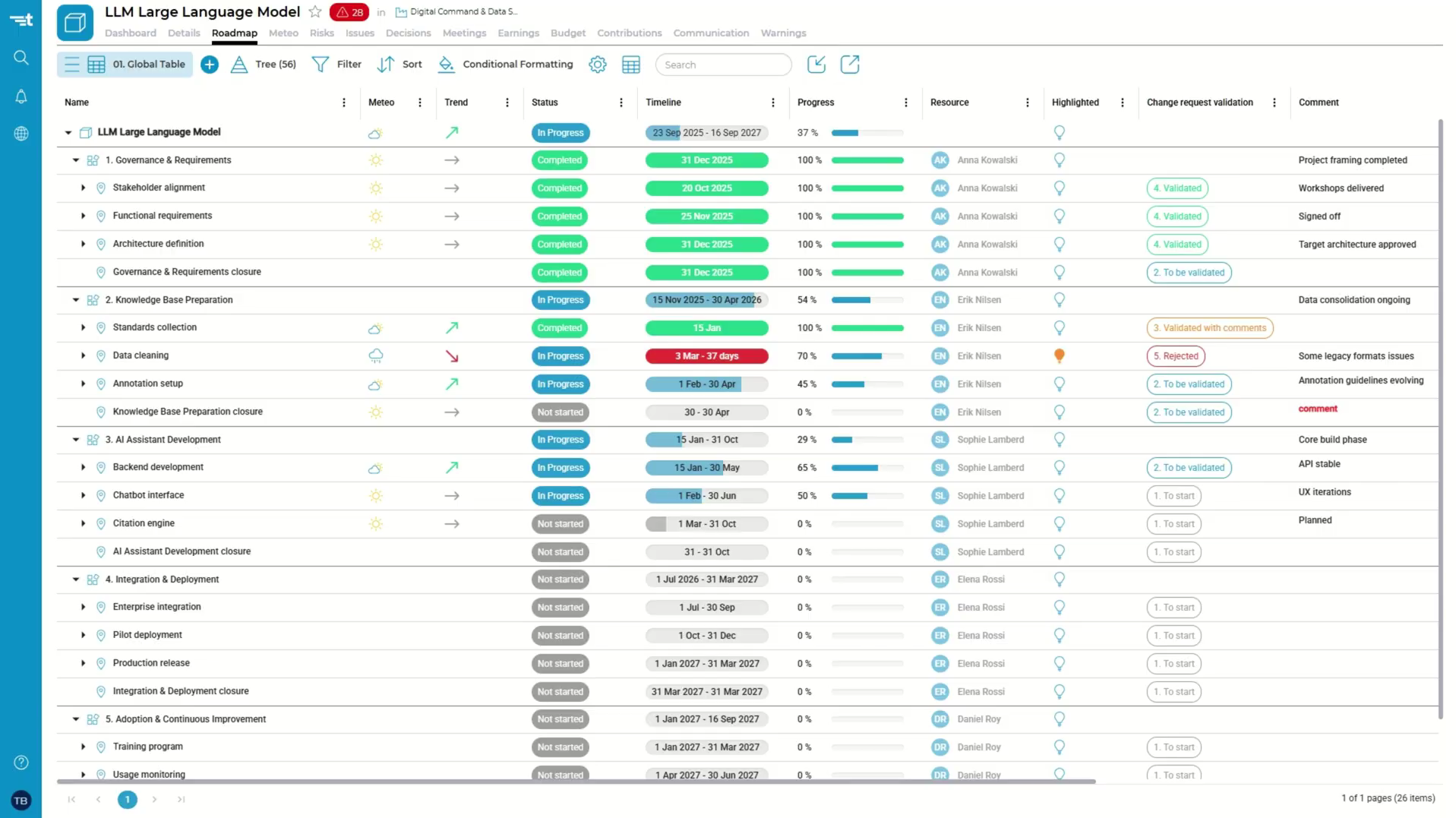
The schedule remains a cornerstone of project management. But in a PPM tool, it should not stand alone. It must be integrated into a broader view of the roadmap, milestones, dependencies, and priorities.
A good PPM tool should allow users to visualize a project’s major phases, key milestones, interdependencies, delays, program-level trajectories, and the overall portfolio roadmap.
Gantt charts, roadmaps, and schedules are designed to help teams understand where projects stand, which milestones are critical, and which decisions can impact the overall trajectory.
The value of a PPM tool lies in connecting these elements to the rest of the management process: risks, actions, decisions, resources, budgets, and reporting.
7. Easy adoption by teams
The success of a PPM tool depends heavily on its adoption. A solution that is too complex, too rigid, or too far removed from real-world usage is likely to remain limited to a handful of expert users.
To be truly effective, a PPM tool must provide enough structure to standardize practices, while remaining easy for contributors to use.
The criteria to consider include:
- the clarity of the interface;
- the ease of contributing;
- customizing views;
- adaptation to user roles;
- detailed rights management;
- the ability to integrate existing methods;
- ease of use;
- the quality of the support provided.
Adoption does not depend solely on technology. It also depends on change management, the quality of configuration, and ongoing training and support for teams.
Check out Florian Lepage’s presentation to explore the topic of tool adoption in greater detail.
Mistakes to Avoid When Choosing a PPM Solution
Choosing a PPM tool based solely on a list of features is a common mistake. A solution may seem very comprehensive on paper, but it may not align with the organization’s actual needs.
1. The first mistake is choosing a tool that is too generic. Some project management platforms are effective for tracking tasks, but they do not always allow you to manage complex portfolios, consolidate data, or establish a multi-level governance structure.
2. The second mistake is to underestimate the importance of configuration. Every organization has its own processes, metrics, levels of governance, and management rules. A good PPM solution must be able to adapt to these specific characteristics without requiring extensive development work every time changes are made.
3. The third mistake is neglecting the needs of contributors. If users in the field do not update the information, dashboards and reports quickly lose their reliability. The solution must therefore make data entry easier, minimize duplicate entries, and ensure that contributions are useful for each user profile.
4. Finally, it is important not to view PPM as merely a reporting tool. Reporting is an outcome, but the value of PPM lies in the steps that come before it: data structuring, the quality of monitoring, analytical capabilities, governance, and decision support.
Why Replace Excel and PowerPoint for Project and Portfolio Management?
Excel and PowerPoint remain widely used tools in organizations. They are flexible, familiar to everyone, and useful for a variety of purposes. But when it comes to managing a project portfolio, they quickly reveal their limitations.
With Excel, data is often scattered across multiple files, updated manually, and difficult to consolidate. Versions are circulated via email, formats vary by team, and the reliability of the information depends heavily on individual discipline.
With PowerPoint, governance materials are often created manually using data copied from multiple sources. This is time-consuming for PMOs and project managers and carries the risk of errors or outdated information.
A PPM tool helps overcome these limitations by centralizing data in a shared environment. Information is updated at the source, dashboards are automatically consolidated, and reports can be generated more quickly. The goal is not necessarily to eliminate all use of Excel or PowerPoint, but to reduce their role in critical management, consolidation, and decision-making processes.
How Tabsters Supports the Management of Projects, Programs, and Portfolios
Tabsters is a project, program, and portfolio management solution designed to help organizations structure their management processes, centralize their data, and improve the quality of their decisions.
The solution supports various levels of management:
- operational monitoring of projects;
- program structure;
- portfolio consolidation;
- the management of actions, risks, decisions, and dependencies;
- monitoring budgets and resources;
- the creation of dashboards;
- preparation of governance bodies;
- automated generation of reporting documents.
One of Tabsters’ strengths lies in its ability to adapt to different user profiles. Project managers, PMO staff, program directors, transformation leaders, and sponsors can access views tailored to their needs, all while working with a shared dataset.
Tabsters also allows you to configure processes, metrics, views, and dashboards according to your organization’s best practices, without imposing a single model. This flexibility is essential for supporting complex, multi-entity, or multi-business-unit environments.
Finally, Tabsters does more than just provide software. The solution includes support for structuring usage, configuration, adoption, and the continuous improvement of management practices.
Discover how leading companies rely on Tabsters to improve visibility, consistency, and efficiency in their management practices.
Conclusion: Choosing a PPM tool means establishing a sustainable framework for management
A PPM tool should not be viewed as merely a project tracking solution. It serves as a tool for structuring, consolidating, and making decisions for organizations that need to manage multiple projects, programs, or portfolios simultaneously. The right tool should centralize information, ensure data reliability, simplify reporting, strengthen governance, and provide each stakeholder with a view tailored to their role.
For PMOs, transformation departments, IT departments, program management teams, and large organizations, choosing a PPM solution is therefore a strategic decision. It determines their ability to prioritize, make trade-offs, and manage projects more effectively over the long term.
With a solution like Tabsters, organizations can transition from a fragmented, manual, and inconsistent management approach to a more structured, collaborative, and consolidated one, thereby enhancing project performance and the quality of decisions.
Would you like to streamline the management of your projects, programs, and portfolios? Find out how Tabsters can help your teams in implementing a PPM tool tailored to your specific challenges.